EMBRACE BOLDLY
The Strategic Architect System

Courage To Embrace. Clarity To Architect. Confidence To Execute.
The Environmental Audit: How to Stop the Invisible Leaks in Your Productivity
The Energy Tax: Why Your Office is Draining You
Have you ever sat down to work with a clear plan, only to find yourself scrolling on your phone or organizing a drawer twenty minutes later?
You likely blamed your "lack of discipline." But in the world of Strategic Architecture, we know that discipline is a secondary resource.
The primary culprit is Systemic Friction.
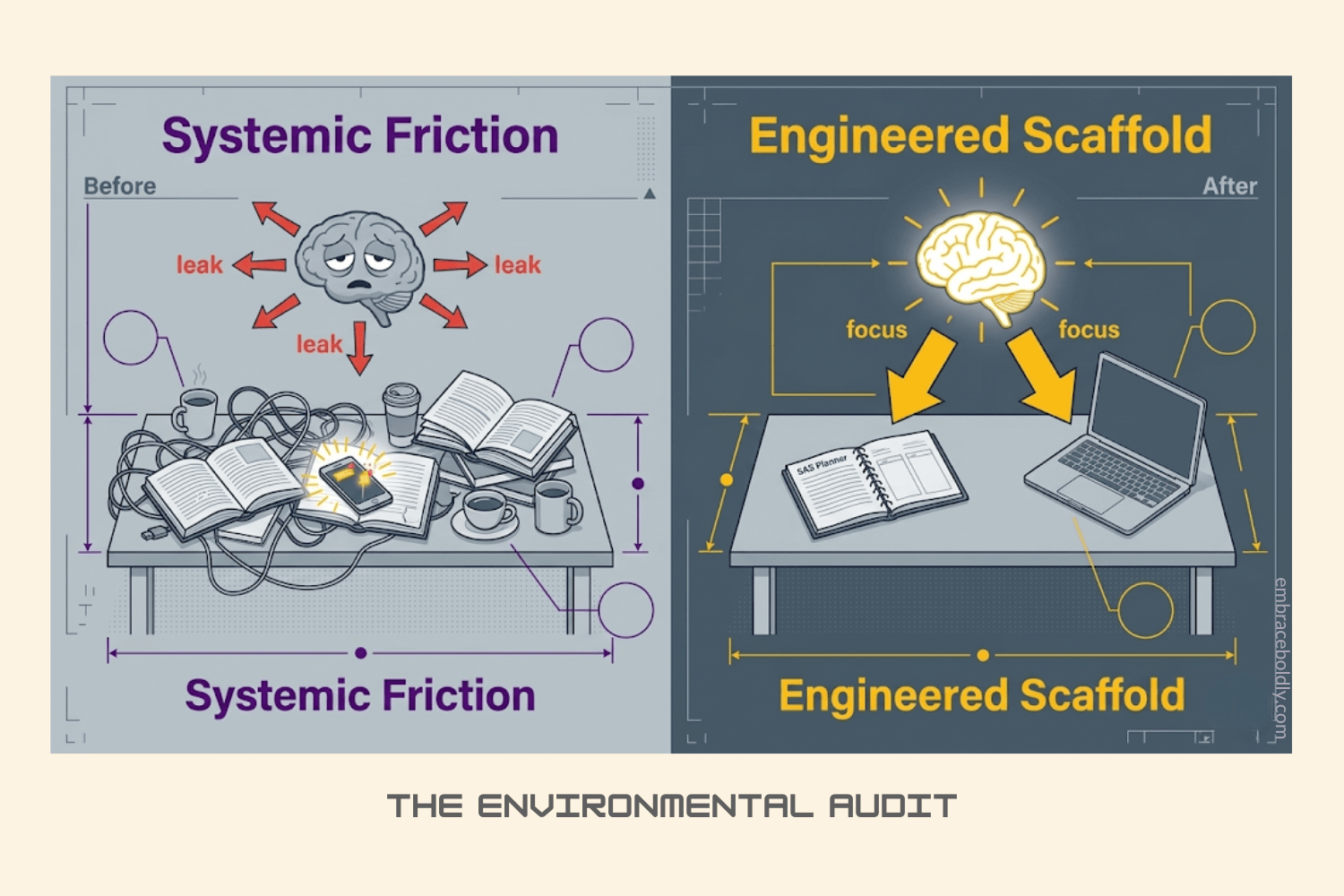
Your Prefrontal Cortex (PFC) is constantly scanning your environment.
Every unwashed coffee cup, every stray paper, and every ping from a notification represents "Neural Noise."
Your brain must use active energy to filter out this noise so you can stay focused.
This is the Environmental Tax, an invisible drain on your finite mental fuel that leads to premature Ego Depletion.
The Discipline Fallacy (The Problem)
Most founders blame a "lack of discipline" for their productivity struggles. In Strategic Architecture, we recognize that discipline is a finite, metabolically expensive resource, like a battery that drains over time.
The real culprit is Systemic Friction. Your environment acts as a persistent gravity well; if it is chaotic, your Prefrontal Cortex (PFC) must expend substantial energy just to filter out the "Neural Noise" of pings and clutter.
This is the Environmental Tax, an invisible drain leading to premature Ego Depletion.
The Problem
Many individuals struggle with focus due to distractions often within their immediate environment. Instead of simply trying to concentrate harder, we can create an engineered approach that eliminates these distractions and simplifies the process of maintaining focus.
The tendency to attribute failure to personal shortcomings fails to recognize a deeper underlying issue. The environment in which one operates plays a critical role in shaping outcomes.
In the realm of Strategic Architecture, we understand that discipline is not a limitless resource.
It is secondary and metabolically expensive. Just like a battery that drains over time, our mental resources can be used up rapidly when faced with constant distractions and inefficiencies.
Rather than relying solely on self-discipline to overcome obstacles, it's vital to consider how our surroundings might be setting us up for failure.
The Metabolic Tax
Your environment acts like a persistent gravity well, pulling you down into a chaotic state where focus becomes elusive.
When the space around you is filled with distractions, be it a noisy workplace, cluttered workspace, or conflicting priorities, your Prefrontal Cortex (PFC) is forced to work overtime.
This part of your brain, responsible for decision-making and self-control, expends a substantial amount of energy just to filter out this chaos.
This phenomenon, termed the "Environmental Tax," significantly hampers cognitive function and focus, leading to what many recognize as premature Ego Depletion.
Essentially, the more chaotic your surroundings, the more mental energy you expend to stay on track, leaving you drained and less capable of tackling important tasks.
The High-Res View
Taking a High-Res View means zooming out to see the broader landscape affecting your productivity. Rather than viewing yourself as the sole factor in your productivity challenges, this perspective acknowledges that external conditions greatly influence your behavior and performance.
You're not simply failing due to a lack of willpower or focus. Instead, it’s your environment that is hindering your potential.
By adopting this viewpoint, you can begin to identify specific environmental factors that may be sabotaging your efforts, such as disorganized workspaces, toxic relationships, or unproductive routines.
With this awareness, you can take actionable steps to reshape your surroundings, optimize your workflow, and create a framework that supports rather than drains your energy.
Ultimately, embracing the High-Res View empowers you to take control of your circumstances and work more effectively toward your goals and intentions.
The Mechanism: Choice Architecture
To stop the leaks, we move from a "reactive" space to an engineered Choice Architecture. This involves deliberately arranging your surroundings so that high-benefit actions are the easiest to accomplish. We stop managing time and start managing Attention Friction.
By identifying "invisible leaks", such as unnecessary notifications, we preserve mental energy for the crucial hours when focus is at its peak.
The goal of an Environmental Audit is to move from a "reactive" space to an engineered "Choice Architecture." We must move from managing time to managing Attention Friction.
In the discussion of the Discipline Fallacy, we explore how our environment significantly influences our ability to focus and manage our time effectively. The central concept is "Choice Architecture," a framework that guides how we design our surroundings to promote better decision-making and productivity.
Choice Architecture
This involves deliberately arranging your environment so that the actions you want to take, those that yield the most significant benefits, are the easiest to accomplish. For example, having a dedicated workspace free from clutter and distractions encourages concentration.
Conversely, putting distractions out of reach creates a physical barrier that makes it harder to give in to them.
Managing Attention Friction
Attention Friction refers to the mental and physical resistance that comes with trying to focus amidst distractions. By rethinking our environments, we can lower this friction.
Instead of battling against our impulses to check our phones or browse the internet, we set up conditions where focusing becomes the natural and easiest choice.
Structural Change
The essence of this approach is about making structural changes to our lives that preemptively remove obstacles to focus. This could mean rearranging a workspace, setting strict boundaries for when and where we check emails, or creating routine environments that foster a flow state for work.
The Friction Map
Finally, identifying "invisible leaks" refers to understanding the unseen factors in our environment that drain our mental energy. These could include unnecessary notifications, clutter, or even the presence of other people who distract us.
Recognizing and addressing these leaks can help preserve our energy for the tasks that matter most, especially in the crucial hours of the day when our focus is often at its peak.
Embracing the principles of Choice Architecture and addressing Attention Friction, we can fundamentally shift how we engage with our tasks and responsibilities, leading to improved productivity and a better overall sense of control in our daily lives.
The 5-Level Environmental Audit Protocol
To achieve "one-read" clarity and immediate results, perform this audit on your workspace today:
Level 1: The Physical Audit (Reducing Friction)
Apply the Clear-Surface Mandate. Remove anything that isn't an External Scaffold, like your SAS Planner. Use the Proximity Rule to keep tools within reach and distractions (like your phone) in another room to create a "Friction Buffer".
Level 2: The Digital Audit (Digital Sovereignty)
Execute a Notification Blackout to stop "Digital Hijackers" from forcing high-cost context switches. Follow the Single-Tab Rule to close visual "Open Loops" that drain mental RAM.
Level 3: The Sensory Audit (Regulating the System)
Use "Brown Noise" or specific frequencies as Aural Scaffolding to mask background sounds.
Level 4: Informational Directories
Address poorly mapped directories. If you cannot find a mission-critical file in three clicks, you are paying a metabolic tax.
Level 5: The Procedural Frictions
Identify your Top 5 Friction Points. Schedule immediate "technical patches" for physical or digital leaks, such as a poorly fitting chair or repetitive login hurdles.
The Strategic Handover:
From Personal to Digital Sovereignty, it is vital to recognize that your environment extends beyond your physical desk.
While the Strategic Architecture System (SAS) engineers your internal biological architecture, a separate, unified infrastructure is required to support your business operations.
To eliminate the "Digital Frankenstein" identified in your audit, we move from personal execution to business engineering.
Our companion entity, LeanGrowthHub (LGH), is dedicated to providing founders with the technical Sovereign Outfits and $0 Unified Business Engines required to reclaim their digital focus.
You are moving from the study of the "Architect" to the construction of the "Engine."
The Result: An Engineered Flow State
An Environmental Audit isn't about "cleaning." It is about engineering a Scaffold that protects your most valuable asset: your attention.
When your environment is aligned with your mission, you stop fighting against your surroundings and start flowing with your system.
The Architect’s Directive: Complete Your Build"
An audit is only as valuable as the reparations that follow. Choose the informational path that aligns with the "leak" you discovered today:
Deepen Your Internal Focus. Understand the biological mechanisms behind the Morning Handover and how to anchor your execution.
➡️ [Read: The Neuro-Architecture of Clarity and Internal Scaffolding]
Address the External Infrastructure
If your audit revealed that your digital environment is the primary source of friction, learn why your internal clarity requires a Unified Business Engine.
➡️ [Read: The Full-Stack Architect—Why Inner Clarity Needs Digital Sovereignty] (
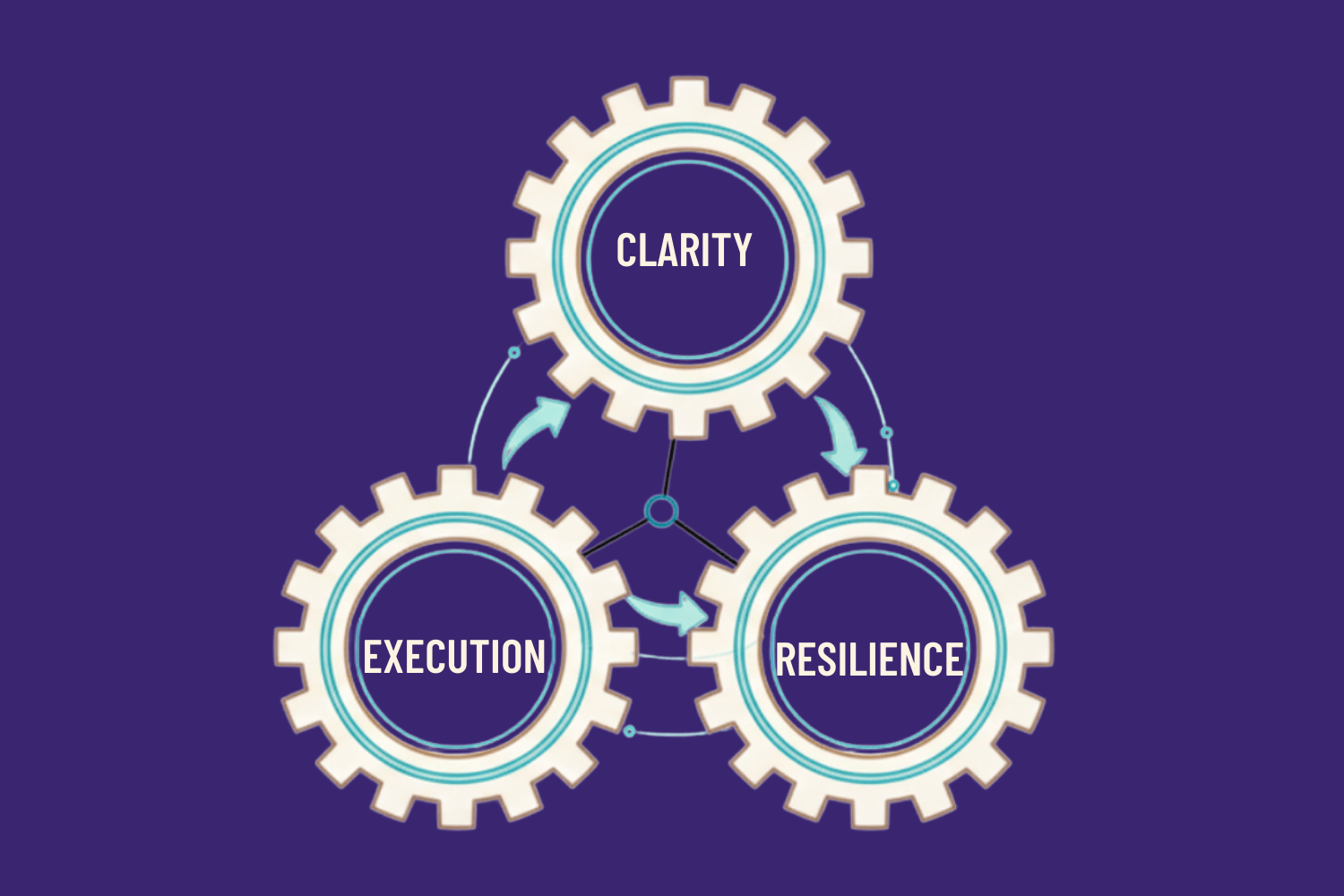
At Embrace Boldly, we dismantle the friction of 'self-help' by replacing vague motivation with Structural Architecture. Through the Triple-Engine Protocol, we empower you to offload cognitive fatigue and build a resilient scaffold for inevitable, high-impact execution.
Subscribe To Our Newsletter

Lost in the Architecture?
If terms like Cognitive Drain or Prefrontal Scaffold are new to you, explore our [Living Glossary] for a plain-English translation of the neuroscience driving our systems.
The Sovereign Manifesto
We believe potential without a system is merely a liability. We move beyond the search for 'possibility' and into the precision of Execution. We provide the blueprints; you build the legacy
Disclosure
Embrace Boldly provides the technical frameworks required to secure your cognitive independence and protect your mental energy. Our products are engineered for sustainable, high-resolution growth through intentional design


© 2026 Embrace Boldly