EMBRACE BOLDLY
The Strategic Architect System

Courage To Embrace. Clarity To Architect. Confidence To Execute.
Stop Trying to Think Your Way to Success: The Neuroscience of Why Your Planner is Your External Brain.
You’re smart. You have ambition. You understand the power of goals.
So why does life feel like a constant, exhausting battle against mental fog? So why does life feel like a constant, exhausting battle against mental fog? Why do your best intentions vanish like smoke the moment the day begins?
It looks like the anxiety of waking up at 3 AM in a cold sweat because you suddenly remembered a critical email you forgot to send. It looks like snapping at your family after work because your brain is completely fried from minor daily choices. It looks like executing a complex workday flawlessly, only to stand in front of your open fridge at 7 PM, paralyzed by the simple choice of what to eat.
The answer to this exhaustion isn't a lack of willpower. It’s a profound biological limit you’ve been ignoring. Most self-help advice fails because it asks you to use your brain for the wrong job.
Here is the inconvenient truth about personal growth and why most self-help advice fails: You are treating your mind like a limitless computer when, in reality, it is a highly sensitive, easily overloaded piece of biological machinery.
The real secret to achieving your goals isn't to think harder. It's to think less.
The Cognitive Drain: Why Your Goals Are Consuming Your Energy
Think about your most complex goal. Maybe it’s launching a side hustle or scaling your current business. You hold this goal in your head, constantly reviewing the steps, the risks, and the deadlines.
That continuous background process isn't free. It’s severely taxing your Prefrontal Cortex (PFC), the brain’s "CEO," responsible for executive functions like impulse control, decision-making, and Working Memory.
Your Working Memory is a limited resource that can only hold about four pieces of information at any given time before it falters. When you load it up with the intention to "start a business," alongside "remember to call the client," your brain constantly keeps recycling that information to keep the intention alive.
This continuous maintenance loop burns copious amounts of glucose, the primary fuel source for the PFC. You are literally exhausting your brain on intention before you even take the first action.
This background process is what neuroscientists call an 'Open Loop', a state where your brain fixates on incomplete tasks at the expense of current focus.
In Module 2, Lesson 2 of our Strategic Architecture System (Volume 01), we deep-dive into the Cognitive Closure Protocol, a specific method for forcibly shutting down these loops to reclaim your mental RAM. Initiate Your Build
The Cost of Cognitive Debt
If you continue to run your life and business by chasing motivation and willpower, you are accumulating Cognitive Debt.
You are forcing your brain to manually calculate complex algorithms when a dedicated, automatic processor is available.
This debt manifests as the constant, low-grade stress of knowing what you should do, but lacking the energy to start.
In business, an automated infrastructure simply cannot be governed by a fatigued, willpower-reliant operator. Your prefrontal cortex becomes the bottleneck, and your execution fluctuates wildly
The Solution: The Basal Ganglia Bypass and Your "External Hard Drive"
To stop this cognitive drain, you must transition your execution from "intention" to "action" through a biological shift known as the Basal Ganglia Bypass. This means shifting recurring, high-impact decisions from the effortful, "Manual" control of your exhausted CEO (the PFC) to dependable, "Automatic" routines.
This is where the paradigm-shifting value of the planner emerges. It is not a tool for scheduling what you already know; it is an External Hard Drive for offloading what you cannot afford to keep internally.
When you use a planner, you are building what neuroscientists call a Prefrontal Scaffold. Simply put, this is a structural support system that holds your "To-Dos," so your brain doesn't have to. You convert a mentally taxing idea ("Be more present") into a stable, concrete structure ("30 minutes, 6:00 PM: Phone is off").
By signaling to your PFC that this essential data is safely stored elsewhere, the continuous internal maintenance loop is shut down.
When you externalize your executive function this way, the business and personal results are quantifiable:
⬇️ 30–50% Reduction in Manual Decisions per week: You stop the exhausting "What should I do now?" loop because your system has already answered it.
⬇️ 20-35% Decline in Context Switching: You eliminate the background cognitive processes that drain your mental RAM.
⬆️ Consistent Output: You gain speed, tighter execution, and the ability to scale without losing control.
Conserving Glucose: The Energy Secret of High Performers
Because the PFC is resource-intensive, conserving its primary fuel, glucose, is paramount.
Overloading it leads to Decision Fatigue, which is why you might feel paralyzed by simple choices at the end of a complex workday.
The planner acts as a glucose-conserving mechanism by pre-determining action steps. This preserved energy becomes the True Currency of Self-Discovery, now available for higher-order cognitive functions like genuine self-reflection and creative insight.
The Subtle Power of the Pen: Activating the RAS
There is another biological mechanism at play: the Reticular Activating System (RAS), a network of neurons that acts as a filter deciding what information gets your conscious attention. In a world of noise, the RAS keeps you sane.
The physical act of writing your goals into a planner, not typing, but writing, engages the RAS far more deeply.
It signals salience, telling your brain, This information is important to prioritize". Writing your commitments, you prime your RAS to start noticing related information in the world around you. Opportunities, people, and resources that were previously invisible to you.
Your brain hasn't gotten smarter; it has simply been given a precise navigational filter.
The Subtle Power of the Pen: Activating the RAS
There is yet another biological mechanism at play: the Reticular Activating System (RAS).
The RAS is a network of neurons running through your brainstem that acts as a filter, deciding what information gets conscious attention and what is filtered out. In a world of noise, the RAS keeps you sane.
The simple, physical act of writing your goals into a planner, not typing, but writing, engages the RAS far more deeply.
It signals salience. It tells your brain, "This information is important. Prioritize it."
By writing out your commitment to "find resources for a business coach" or "notice three moments of gratitude today," you prime your RAS to start noticing related information in the world around you suddenly. Opportunities, articles, people, and resources that were always there become instantly visible.
Your brain hasn't gotten smarter; it has simply been given a precise navigational filter.
The Cost of Inaction: What You're Losing Right Now
Every moment you spend trying to hold complex intentions in your mind, you are paying a hidden tax, one that compounds with every hour of hesitation.
You are not merely draining energy for today’s tasks; you are actively sabotaging your capacity for Self-Discovery. The high-resolution energy required to ask who you are, what truly matters, and how you will build your legacy is being burned on the low-resolution task of simply remembering what you have to do next.
You are choosing mental clutter over profound insight. You are trading your sovereign potential for the "Digital Frankenstein" of a scattered mind.
Don’t let the simplicity of a physical planner deceive you. It is a sophisticated cognitive weapon engineered to secure your executive command.
The time to reclaim your most expensive and demanding resource, your mental RAM, is now.
The Profound Philosophical Shift: Beyond Willpower
This scientific understanding collapses one of the most destructive myths of personal transformation: the belief that you are a creature defined by sheer, brute willpower.
Most people fail their goals because they try to beat their biological limits with moral force. They view discipline as a measure of character.
The philosophical shift is this:
You stop perceiving yourself as a struggling aspirant whose character is judged by how often you resist temptation
You must start recognizing yourself as a biological system of limited, conserved resources.
The planner is not a moral scorecard; it is the ultimate tool for resource management.
You don't hope to be successful; you strategically design success by respecting your brain's constraints.
You move from a state of hopeful wishing to a position of strategic architect. You don't hope to be successful; you strategically design success by respecting the constraints of your own remarkable brain.
When you consistently use a planner to externalize your executive function, you are not being "organized." You are optimizing the most expensive and limited resource you possess: your cognitive capacity.
Actionable Next Step: Build Your Scaffold
📌 BOOKMARK THIS: The Weekly Neuroscience Planning Ritual
Stop carrying the weight of your intentions. To immediately stop the cognitive drain and build your Prefrontal Scaffold, execute this 4-step workflow every Sunday evening:
Step 1: The Cognitive Dump (Clear the RAM) Set a timer for 5 minutes. Get every swirling commitment, vague goal, client promise, and looming worry out of your head and onto a blank page. You cannot organize what you haven't externalized.
Step 2: The Basal Ganglia Bypass (Automate the Recurring). Look at your list. Identify the decisions or tasks that repeat every week (e.g., client follow-ups, meal planning, content creation). Assign these to a permanent, automatic slot in your week. Decide once, so your brain never has to manually deliberate on them again.
Step 3: Construct the Prefrontal Scaffold (Timeblock the Taxing). Identify the single most mentally taxing item on your cognitive dump list. Do not leave it as a vague "To-Do." Translate it into a specific, concrete structure and schedule a dedicated 30-minute block for it in your planner for tomorrow.
Step 4: Activate the Navigational Filter (Write the Top 3) Physically write down your top 3 most important outcomes for the week using a pen. This physical act signals your Reticular Activating System (RAS) to prioritize these goals, filtering out distractions and highlighting resources that will help you achieve them.
This is not just planning. This is neuroscience applied to your success. You are conserving your glucose, bypassing willpower, and freeing your mind to finally do the deep work of scaling your life and business.
Start designing your success today.
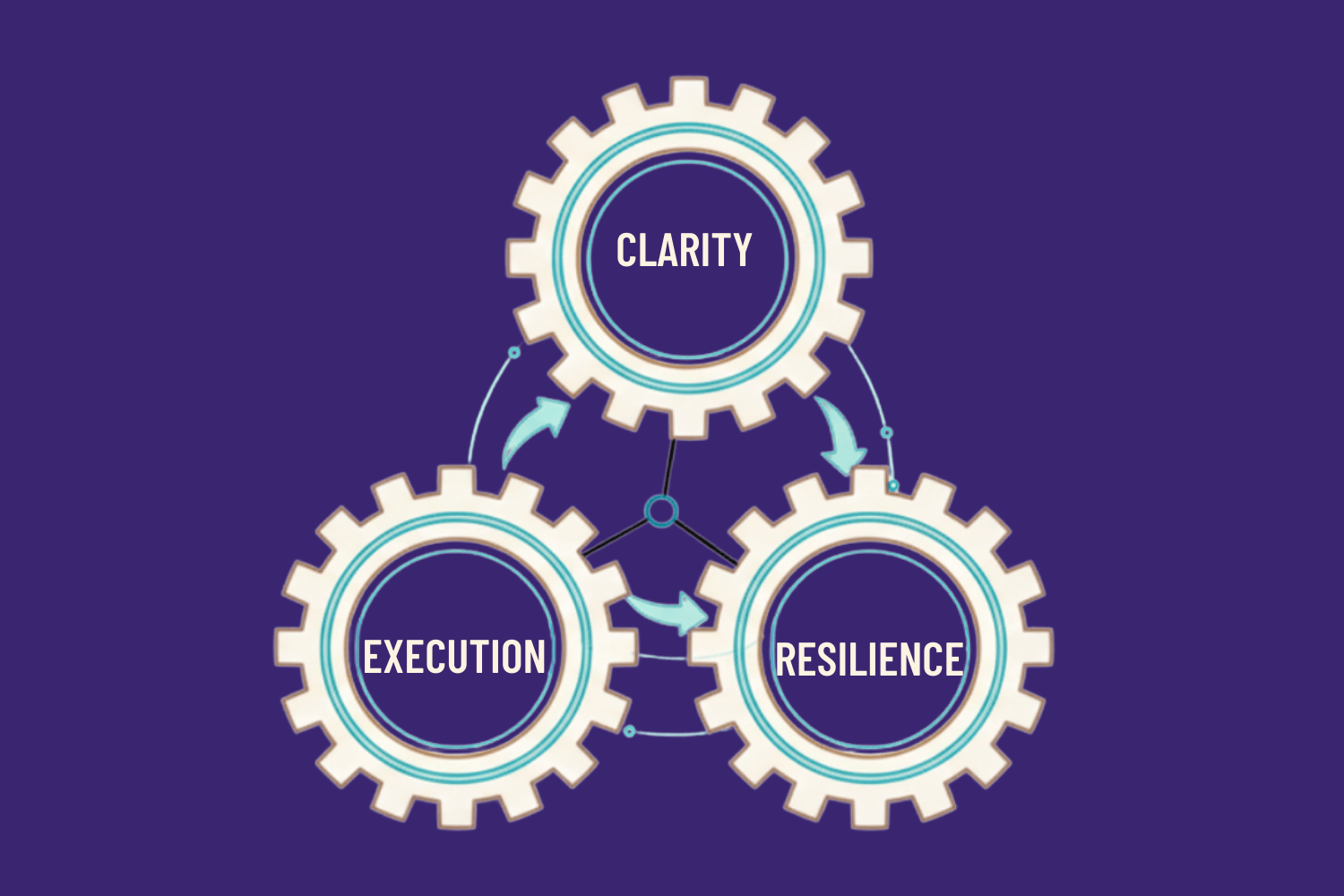
At Embrace Boldly, we dismantle the friction of 'self-help' by replacing vague motivation with Structural Architecture. Through the Triple-Engine Protocol, we empower you to offload cognitive fatigue and build a resilient scaffold for inevitable, high-impact execution.
Subscribe To Our Newsletter

Lost in the Architecture?
If terms like Cognitive Drain or Prefrontal Scaffold are new to you, explore our [Living Glossary] for a plain-English translation of the neuroscience driving our systems.
The Sovereign Manifesto
We believe potential without a system is merely a liability. We move beyond the search for 'possibility' and into the precision of Execution. We provide the blueprints; you build the legacy
Disclosure
Embrace Boldly provides the technical frameworks required to secure your cognitive independence and protect your mental energy. Our products are engineered for sustainable, high-resolution growth through intentional design


© 2026 Embrace Boldly